To start an e-commerce company in Turkey, forming the legal entity is only the first milestone. A company is ready to sell when its corporate records, registered address, tax/accounting workflow, bank and payment path, invoicing route, ETBIS position, consumer documents, product controls and fulfilment process all match the actual sales model.
For many foreign-owned online businesses, a Turkish limited liability company (Ltd. Şti.) is a practical operating structure, but it is not automatically the best choice for every founder. A joint-stock company (A.Ş.) can be more suitable where governance, future investors, share transfers or capital-market planning justify the extra structure.
Last verified: 17 September 2026. This guide explains the legal entity → sales-ready operating stack. For broad market, channel and consumer-compliance strategy, use the E-Commerce in Turkey market and compliance guide. If you are a foreign founder still deciding whether a Turkish entity is the right entry route, use the foreign-founder e-commerce entry guide.
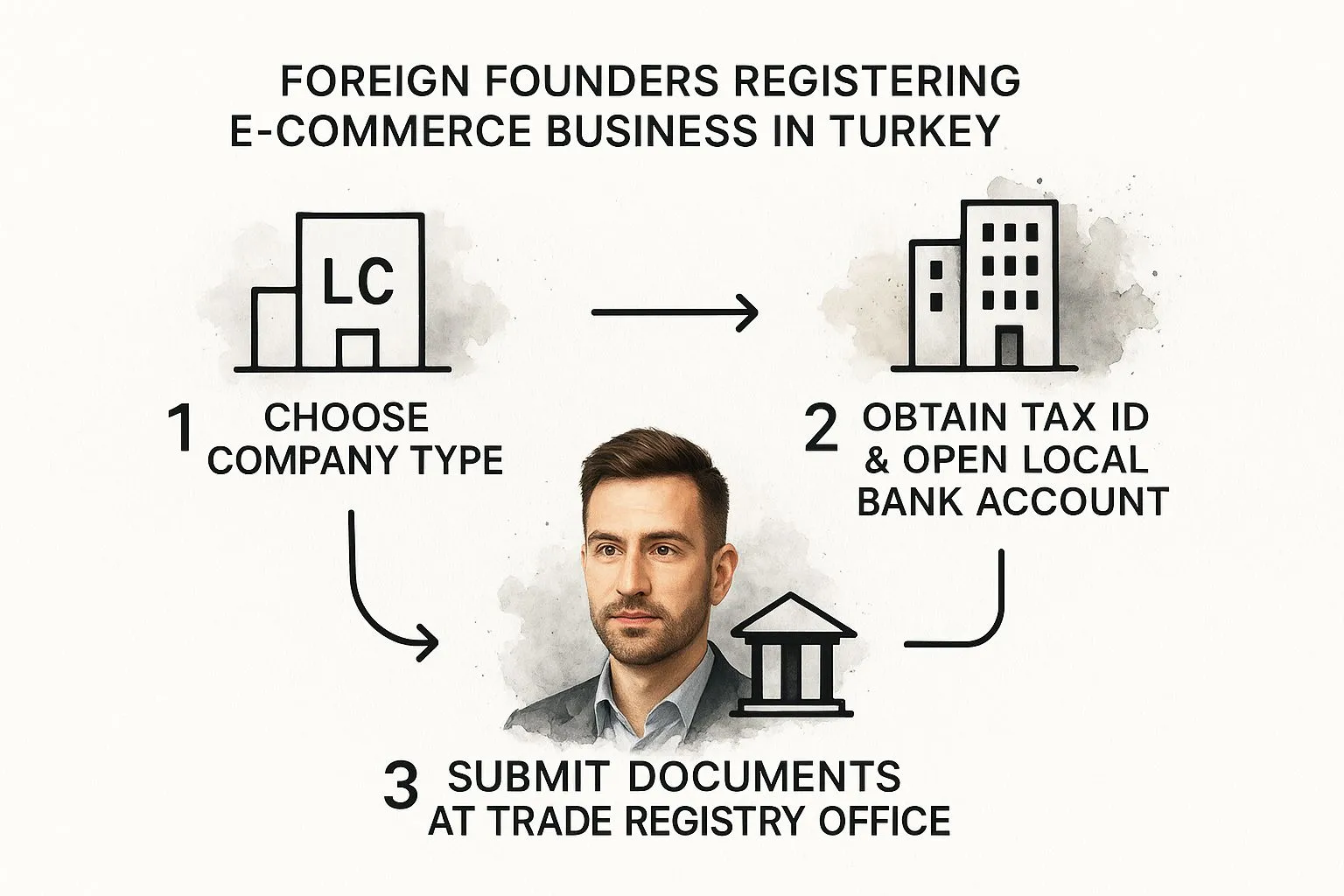
Formation is the first layer; banking, invoicing, e-commerce and product controls complete the go-live stack.
2026 E-Commerce Company Setup: The Seven Layers
| Layer |
What must be ready |
Do not confuse it with |
| 1. Legal entity |
Company type, shareholders, management, scope, capital and Trade Registry registration |
A licence to sell every product |
| 2. Corporate operating file |
Registered address, authority/signature evidence, ETDS books and core company documents |
Bank or marketplace approval |
| 3. Tax/accounting |
Taxpayer records, bookkeeping workflow, VAT/tax classification, filing responsibilities |
One universal tax rate |
| 4. Banking/payments |
Corporate banking KYC, settlement account and merchant/payment-provider onboarding |
Automatic approval after incorporation |
| 5. Invoicing |
Correct e-Fatura/e-Arşiv route and order-to-invoice reconciliation |
Automatic e-Fatura entry for every new company |
| 6. E-commerce compliance |
ETBIS route, seller disclosures, consumer documents, commercial-message/data controls |
A generic website privacy page |
| 7. Product and fulfilment |
Product approvals/labels where required, stock, customs, courier, returns and evidence |
Company-registration completion |
Step 1: Choose Ltd. Şti. or A.Ş. for the Operating Model
Turkey’s foreign-investment framework generally gives international investors the same company-establishment rights and liabilities as domestic investors. Foreign shareholders can therefore establish company forms available under the Turkish Commercial Code, subject to sector-specific restrictions where applicable.
| 2026 formation point |
Limited company (Ltd. Şti.) |
Joint-stock company (A.Ş.) |
| Minimum capital |
TRY 50,000 |
TRY 250,000 under the ordinary capital system; TRY 500,000 starting capital if the registered-capital system is adopted |
| Pre-registration capital payment |
No universal 25% pre-registration deposit; subscribed capital may be paid within 24 months after establishment |
At least 25% of subscribed capital before registration; balance within 24 months |
| Typical e-commerce use |
Founder-led operating company, SME, trading/import-export and direct/marketplace sales |
Investor/governance-heavy structure, wider share-transfer or financing plans |
| Decision driver |
Operational simplicity and ownership needs |
Governance, investment and ownership architecture |
The minimum capital is a statutory floor, not a realistic working-capital budget. Inventory, customs, platform deposits, advertising, salaries, returns and tax cash flow can require substantially more funding.
Do not repeat the old rule that every Turkish company must deposit 25% before registration. The Ministry of Trade and Invest in Türkiye expressly distinguish the limited-company rule from the A.Ş. rule.
Official Ministry of Trade company information · Invest in Türkiye establishment guide.
Step 2: Define the Sales Model Before Drafting the Company Scope
Before the incorporation file is finalised, document what the company will actually do. The articles and operational records should not be drafted from a generic “e-commerce” template if the real business will also import, export, manufacture, hold regulated goods, operate multiple brands or provide services.
Answer these questions first:
- Will sales be B2C, B2B or both?
- Will the company sell through its own site/app, a Turkish marketplace, a foreign marketplace, or a combination?
- Will inventory be purchased in Turkey, imported, manufactured or drop-shipped?
- Will the company export from Turkey?
- Are the products regulated or subject to special labelling/registration?
- Will a warehouse, fulfilment centre or only a registered office be used?
- Who will have authority to sign, operate bank accounts and complete platform onboarding?
The legal entity should be broad enough for the genuine business model without pretending that a trade-registry activity clause replaces a sector licence or product approval.
Step 3: Prepare the Foreign-Shareholder Formation File
The exact evidence depends on whether the shareholder is a foreign individual or foreign legal entity and whether the process is handled personally or by authorised proxy. Common formation controls include:
- potential Turkish tax identification numbers for relevant foreign founders/board members;
- passport or foreign-company identity/authority documents as applicable;
- Turkish translation, apostille/legalisation or consular formalities where required for the specific foreign-issued document;
- registered Turkish company address;
- MERSIS formation data and articles of association;
- management/representation and signature declarations;
- Competition Authority contribution where applicable; and
- capital evidence according to the chosen company type.
A power of attorney can allow authorised representatives to handle many formation steps when properly drafted for the required acts. Do not assume that one generic POA wording covers tax, registry, banking and every later institutional process.
For the wider corporate sequence, use the company formation in Turkey guide.
Step 4: Complete Registration and Build the Corporate Evidence Pack
Trade Registry registration creates the company, but the practical launch file should also contain a clean, internally consistent set of current corporate evidence.
- Trade Registry registration and Gazette publication;
- taxpayer/tax-office records;
- current registered-address evidence;
- representation and signature evidence;
- current chamber/activity evidence when a recipient requests it;
- shareholder/management records;
- banking KYC pack; and
- all foreign-document translations/legalisation evidence retained with the originals.
Names, passport details, trade name, address, MERSIS/tax information and authority wording should reconcile across this pack. A marketplace or bank may reject a file that is legally valid but internally inconsistent.
2026 ETDS rule for new companies
A major 2026 corporate change sits outside ordinary bookkeeping: companies whose establishment is registered from 1 January 2026 are required to keep the share ledger and general assembly meeting and negotiation book in the Electronic Commercial Ledger System (ETDS). The Ministry states that those electronic books are opened automatically with registration. Keeping the board-resolution book electronically is optional under the current announcement.
Official Ministry ETDS announcement.

Keep corporate identity, banking and payment evidence consistent across every onboarding file.
Step 5: Set Up Tax and Accounting Before the First Order
A Turkish e-commerce company should not wait for sales to start before defining accounting ownership. At minimum, establish:
- who maintains the statutory accounting records;
- how sales, marketplace settlements, payment-provider deductions and refunds are imported/reconciled;
- how VAT is assigned by product/service;
- how foreign-currency, import and customs records feed the books;
- how expense invoices are collected and approved;
- how stock and cost of goods sold are reconciled; and
- who monitors filing and e-document triggers.
Do not describe a licensed CPA/SMMM as a universal prerequisite to Trade Registry incorporation. In practice, companies need an appropriate accounting/tax compliance workflow after incorporation, and professional-signature/e-filing requirements depend on taxpayer and filing rules. Workon can coordinate onboarding with licensed professionals but does not replace regulated tax/accounting work.
For the first-year company calendar, use the business taxes in Turkey guide.
Step 6: Treat Corporate Banking as a Separate KYC Milestone
Company registration does not guarantee bank-account approval. Banks apply their own KYC/AML and risk controls and can ask for shareholder, UBO, business-model, source-of-funds, expected-transaction, contract, address and activity evidence.
Prepare a bank file that explains:
- who owns and controls the company;
- who can sign and operate the account;
- what products/services will be sold;
- which countries, platforms and currencies are expected;
- how money enters and leaves the company; and
- how the operating model matches the registered corporate records.
Do not promise that a foreign founder will always be able to open the account fully remotely or that every bank requires the same in-person process. Banking routes and risk decisions vary. Use the business bank account guide for the dedicated decision.
Step 7: Complete the Channel-Specific ETBIS Check Before Go-Live
Record the ETBIS decision for the actual seller and channel before launch. An own website or app, a domestic-marketplace-only seller and a Turkey-resident seller using a foreign intermediary do not necessarily follow the same registration and reporting route. Use the e-commerce market and compliance guide for the route comparison and the official ETBIS FAQ for the applicable requirements.
Turn that decision into a launch record:
- Identify the seller and every channel. Reconcile the legal name, tax and MERSIS information, domains, apps and marketplace accounts.
- Document the applicable route. Record whether registration or notification is required, why that route applies and who completes it.
- Complete the pre-launch steps. Retain confirmation and check that the registered seller and channel information match the live store.
- Check seller disclosures separately. A marketplace-only position does not remove the seller-information requirements. Confirm the required identity, KEP, address and contact fields in the platform’s allocated seller area.
- Assign follow-up reporting. Calendar any applicable cross-border notification and reassess the route when a new website, app, marketplace or seller entity is introduced.
Keep the route decision, submission evidence and live-store checks with the go-live file. Do not mark the ETBIS task complete merely because a developer has launched the website or a marketplace has opened a seller account.
Step 8: Build the Consumer and Data Layer into Checkout
For B2C distance sales, consumer compliance belongs inside the order flow. Before payment, the customer should receive the required pre-contract information, including the main characteristics of the goods/services, seller/intermediary identity and contact data, total price including taxes, delivery/additional costs, withdrawal-right information and available remedies.
The general covered distance-contract framework includes a 14-day withdrawal right with statutory exceptions. The exact return/refund path should be built into customer service, fulfilment and payment reconciliation before launch.
Separately, customer data and marketing communications require a Turkey-specific KVKK and commercial-message/IYS analysis where applicable. Order fulfilment data, marketing consent and advertising/cookie data should not be treated as one legal basis.
For the broader consumer/channel rules, use the E-Commerce in Turkey compliance hub.
Step 9: Configure e-Fatura and e-Arşiv by Trigger and Recipient
Do not tell a new e-commerce company that every sale must automatically use e-Fatura from day one. e-Fatura entry can arise from turnover, sector/activity rules, specific mandates or voluntary entry. e-Arşiv is a separate route, including electronic invoices to recipients outside the e-Fatura registered-user population where applicable.
The order system should know:
- whether the company is an e-Fatura user;
- whether the recipient is registered in e-Fatura;
- which document route applies;
- how cancellations/returns are reflected;
- how marketplace and payment settlement is reconciled to invoices; and
- who monitors future transition triggers.
Use the e-Fatura registration guide and e-Arşiv guide for the detailed rules.
Step 10: Add the Payment Provider Only After the Seller File Is Ready
A Virtual POS or payment institution will evaluate the company and merchant activity independently. Product category, website disclosures, refund policy, chargeback risk, company documents, bank account, integration and expected volume can affect onboarding.
Do not choose a provider from a static fee table. Build a comparison with:
- merchant eligibility and restricted categories;
- cards and instalment features actually needed;
- integration method and security requirements;
- settlement cycle and reserves;
- refund/chargeback workflow;
- marketplace versus own-site payment path; and
- total effective cost at your actual average order value.
Use the Virtual POS in Turkey guide for payment onboarding.
Step 11: Verify Product and Customs Requirements Before Buying Inventory
Formation does not authorise the company to place every product on the Turkish market. Before purchasing inventory, classify the product and determine whether the company is acting as manufacturer, importer, distributor or seller.
| Control |
Question before purchase |
| Product regulation |
Does this category require registration, conformity assessment, safety documentation or a regulated operator? |
| Labelling |
What Turkish-language, importer/producer, warning or consumer information is required? |
| Customs |
What GTIP, origin, customs-value, TAREKS or other import controls apply? |
| Tax |
What VAT/SCT treatment applies? |
| After-sale |
What warranty, withdrawal, return or service obligations apply? |
Imported inventory should be planned through the customs clearance steps guide. Specialist categories such as food, cosmetics or medical devices require dedicated regulatory analysis.

Product, stock, delivery and return controls should be validated before marketing spend scales.
Sales-Ready Checklist: Do Not Go Live Until These Are Owned
- Company: registered, correct scope, current corporate evidence.
- Address: registered and operationally usable for the company model.
- ETDS: covered 2026 company books active and ownership assigned.
- Accounting: order/payment/invoice/stock reconciliation designed.
- Bank: settlement account and KYC route ready.
- ETBIS: channel-specific requirement decided before launch.
- Consumer: pre-contract, withdrawal/return and customer-service process live.
- Data/messages: KVKK and commercial-message controls mapped.
- Invoice: e-Fatura/e-Arşiv decision and integration tested.
- Payment: merchant account approved and refund/chargeback tested.
- Product: product, label and import permissions verified.
- Fulfilment: stock, courier, return and reverse-logistics workflow tested.
A company is sales-ready when all twelve controls have an owner and evidence, not when the Trade Registry certificate alone has been issued.
How Workon Supports the Setup
Workon can coordinate the company-side setup for foreign e-commerce founders: incorporation, registered business address and office solutions, document workflows, bank-account application support and the handoff to appropriately licensed accounting, legal, customs, data-protection and product-compliance professionals where those workstreams apply.
Review Workon’s company registration support and use the sales-ready checklist above to define what must be completed after incorporation.
Company registration is only the first layer. The business should also have a suitable registered address, tax and accounting workflow, corporate banking and payment path, the correct invoicing route, its ETBIS position, consumer and data-protection controls, product compliance and a workable fulfilment and returns process.
Not by itself. An e-commerce company follows the general company-law capital rules for the legal form it chooses unless a separate regulated activity imposes additional requirements. The company type should be selected for ownership, governance and operating needs rather than because the business sells online.
Before go-live, after the sales channel and legal seller are clear. Own-site, marketplace-only and foreign-intermediary models do not necessarily follow the same ETBIS route, so determine the applicable registration or reporting position from the actual channel rather than assuming one rule for every seller.
No. A merchant or tradesperson selling through a domestic intermediary can still have seller-information disclosure duties in the marketplace area allocated to it, including current trade\/business identity, KEP, MERSIS or other applicable identifiers, address and verified-contact information under the Ministry's current rules.
No. e-Fatura entry can depend on turnover, sector or activity rules, a specific mandate or voluntary entry. e-Arşiv is a separate invoicing route. The company should determine the correct document type based on its own status and the recipient.
No. Banks and payment providers apply their own KYC, risk and merchant-onboarding rules. They can review the company, shareholders and UBOs, activity, products, expected transactions, website disclosures, settlement model and source of funds before approval.
No. Company formation does not replace product-specific compliance. Before buying or importing inventory, the business should check product classification, approvals or registrations, Turkish labelling, customs and TAREKS requirements where applicable, VAT or SCT treatment, and consumer or after-sales obligations.
Disclaimer: This article provides general information about forming and preparing an e-commerce company for operation in Turkey as of September 2026 and is not legal, tax, accounting, consumer-law, banking, data-protection, customs or product-compliance advice. Requirements depend on the company type, shareholders, channel, products and current rules. Verify material formation and launch decisions against official sources and with appropriately qualified Turkish professionals.