You’re probably at the point where the group structure has become more important than the next deal. A Turkish operating company is already in place, or you’re about to buy one, and someone on your side has asked whether it makes sense to insert a holding company in Turkey above it. The right answer is not marketing-driven. It depends on how Turkish law treats the structure, what the Ministry of Trade will review, and whether you’re prepared for the capital, documents, and ongoing compliance that come with a real corporate vehicle.
A Turkish holding is not a magic tax wrapper. It is a joint-stock company (anonim şirket, A.Ş.) whose main activity is participation in other companies; it should not be confused with the separate legal concept of a group of companies (şirketler topluluğu). That distinction matters from day one. It affects how you draft the articles of association, what the Trade Registry expects, whether Ministry approval is needed, and how you should think about tax, banking, and governance before you commit capital.
What a Holding Company in Turkey Actually Is
A foreign founder usually starts with a practical problem, not a legal theory. You may already control three Turkish operating companies, a property portfolio, and a distributor in the region, and now you want one Turkish entity to sit above them and coordinate ownership. That’s the right moment to ask whether a holding company in Turkey adds real structure, or just another layer of paperwork.
Functional structure, not a separate legal form
Under the Turkish Commercial Code No. 6102, a holding company is not a separate company type. In practice it is organised as a joint-stock company (A.Ş.) whose principal purpose is participation in other enterprises. Article 519(4) addresses the treatment of statutory reserves for holding companies; it should not be presented as a stand-alone incorporation definition. The company’s objects, trade name and Ministry-permission requirements must be assessed together. In practice, the holding model is a legal structure built around control, participation, and group coordination, which is why many Turkish holdings are incorporated as A.Ş. entities. Turkish holding company legal structure and Article
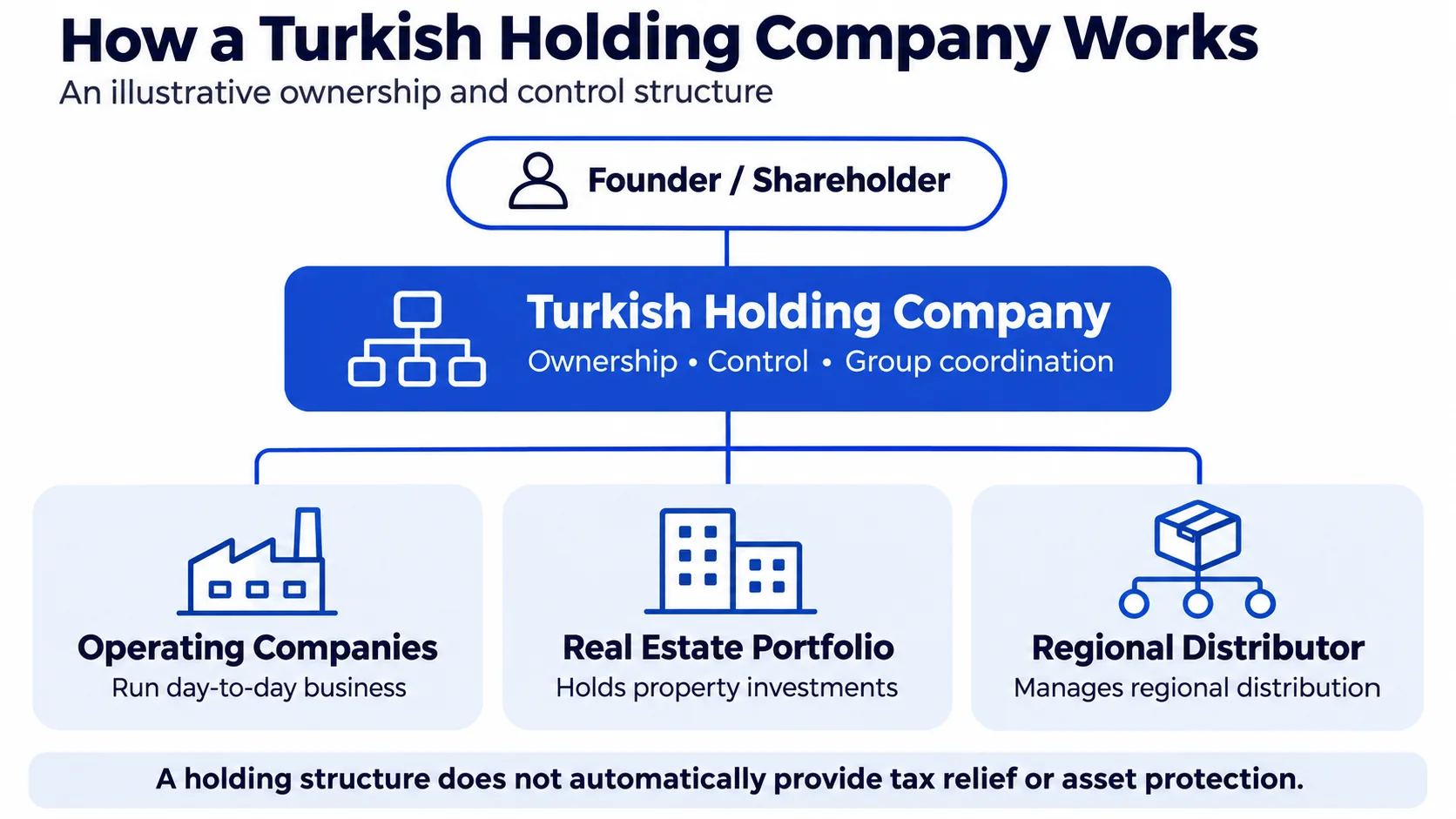
An illustrative Turkish holding structure showing how ownership, control and group coordination connect different businesses and investments.
A holding may primarily own shares, while a wider group may also need management, IP or treasury services. Before putting those activities into the holding itself, obtain legal advice on whether the proposed objects and actual activities remain consistent with the holding-company classification and Ministry approval. That distinction matters because tax treatment follows the actual function, not the label on the company name. If the company only owns shares, the analysis is different from a structure that actively charges subsidiaries for services or centralises cash management. A label alone does not change substance.
Practical rule: don’t buy the idea that “holding” automatically means special tax treatment or insulation from risk. The registry entry creates a company, not a promise.
What it does and what it does not do
A holding structure can centralise ownership, create one control point for the group, and make subsidiary governance easier to manage. This article focuses specifically on holding-company formation and group structure; for the wider LLC/JSC formation process, see the company formation guide, and for A.Ş. board decisions see the board resolution guide. It can also help separate business lines administratively. What it does not do is create automatic tax savings, automatic residency, or built-in asset protection. Those outcomes depend on the actual legal and tax position of the group, and that analysis belongs with licensed Turkish counsel and tax advisers.
The common mistake is to treat the holding label as the main event. It isn’t. The main event is whether the entity’s purpose, capital, documents, and governance fit the group you’re building. If you’re only running one Turkish operating company, the holding layer is often over-engineering. If you’re coordinating multiple subsidiaries or regional participations, the structure may make sense, but only after proper legal and tax review.
Holding Versus Operating Company Versus Foreign Subsidiary
Foreign investors usually compare three structures, even if they don’t say it that way. The first is a Turkish holding A.Ş. above existing Turkish companies. The second is a plain operating A.Ş. doing trade, manufacturing, or services on its own account. The third is a foreign-parent Turkish subsidiary, where the Turkish company is owned directly by a non-resident parent with no Turkish holding in between.
The choice is about architecture, not slogans
A holding A.Ş. makes sense when the group already has, or expects to have, multiple entities and you want one place for equity ownership, dividend coordination, financing flows, and group oversight. An ordinary operating company is the cleaner answer when you only need one Turkish vehicle to run the business. A foreign-parent subsidiary is the simplest cross-border setup when the foreign parent wants direct control and doesn’t need an intermediate Turkish layer.
The right answer is usually visible from the group chart. A holding company can legally exist before it acquires any subsidiaries; it is not the same thing as a legally defined group of companies. But if you have only one operating business, an additional holding layer may add cost and administration without solving a real problem. Multiple investments, separate business lines or a planned acquisition programme can make the structure more defensible.
| Criterion |
Turkish Holding A.Ş. |
Ordinary Turkish Operating A.Ş. |
Foreign-Owned Turkish Subsidiary |
| Parent nationality |
Turkish or foreign ownership possible |
Turkish or foreign ownership possible |
Directly owned by a foreign parent |
| Number of Turkish vehicles |
Usually sits above other companies |
Usually one active trading entity |
Usually one Turkish entity under a foreign parent |
| Governance complexity |
Higher, because group oversight is the point |
Lower, because the company operates directly |
Moderate, because ownership is direct but foreign control still needs coordination |
| Capital efficiency |
Better only if the group structure justifies it |
Better for a single operating business |
Efficient for simple market entry |
| Typical tax leakage points |
Dividend withholding, transfer pricing, service charge substantiation |
Dividend withholding, operating profit taxation |
Dividend withholding, branch-style planning not relevant unless the structure changes |
| Fit with participation-exemption planning |
Relevant if the structure meets legal conditions |
Usually less relevant unless there are participations |
Relevant only if the foreign parent is using a Turkish intermediate company |
If you want a broader structural comparison before choosing the layer above your business, the most useful next read is the guide on subsidiary, branch office and liaison office structures in Turkey.
Use the simplest structure that fits the group
My recommendation is blunt. Choose the structure that matches the number of entities you need. Don’t force a holding into a one-company setup just because it sounds impressive. Most single-subsidiary cases do not need a holding layer. That’s not a conservative opinion, it’s the practical one.
A foreign parent should also remember that direct ownership in a Turkish company is already a valid cross-border setup. You do not need a Turkish holding just to be “present” in the market. If the goal is control, a foreign-parent subsidiary may be enough. If the goal is group coordination across several Turkish entities, then the holding discussion becomes serious.

Simplify your business setup with Workon’s all-in-one company registration service in Turkey.
Legal Form, Capital and Ministry Approval
The incorporation sequence matters more than the logo on the share certificate. Start by mapping shareholders and intended participations; have Turkish counsel confirm the articles and Ministry permission route; prepare the foreign-shareholder documents and MERSİS filing; arrange the required cash-capital payment; obtain permission and complete trade registry registration in the prescribed order. Coordinate bank onboarding and tax/accounting readiness in parallel where possible. The precise sequence of signatures, approvals and bank documents should be confirmed with the relevant registry and advisers.
The setup path you actually have to follow
A Turkish holding is commonly established as an A.Ş., and the practical incorporation steps start before the registry filing. The process usually includes securing a tax number, preparing notarised articles of association, depositing capital into a Turkish bank account, registering with the Trade Registry, and then completing tax and social security registrations if employees will be hired. Practical incorporation sequence for a Turkish holding company
Under the rules effective from 1 January 2024, the general minimum share capital for a Turkish joint-stock company (A.Ş.) is TRY 250,000. For a non-public A.Ş. adopting the registered-capital system, the minimum initial capital is TRY 500,000. These are different capital regimes; TRY 500,000 is not a universal minimum for every holding company. For cash capital subscriptions, at least 25% must generally be paid before registration, with the balance due within 24 months. Additional capital requirements may apply to regulated activities. Verify the proposed holding’s precise structure and approval requirements before filing. See the Turkish Ministry of Trade’s company guidance. Capital thresholds and paid-in-capital mechanism for Turkish holdings 25% before registration, 75% within 24 months rule
Practical rule: the bank and the registry don’t care what your slide deck says. They care whether your file is complete, your capital is traceable, and your paperwork matches the chosen company type.
Why Ministry approval matters
Under the Turkish rules on companies subject to Ministry of Trade permission, holding companies are among the joint-stock companies whose establishment and amendments to their articles of association require Ministry permission. This is a distinct step from trade registry registration. Confirm that the proposed articles, activities and participation structure fall within the applicable holding-company category, and obtain the required permission before proceeding to registration. Additional sectoral permissions may be necessary if the group will conduct regulated activities.
The legal wording also means you should not assume registry filing alone completes incorporation. It doesn’t. The company is formed through a chain of actions, and the Ministry review sits inside that chain where required. If the articles are drafted loosely, or if the target structure is not aligned with the intended holding purpose, expect delays.
Articles of association and formation documents
The articles of association need to reflect the company’s purpose clearly. For a holding, that means the purpose should point to participations, subsidiary control, and group management, not ordinary commercial trading as the main story. Foreign shareholders’ identity and corporate documents usually have to be apostilled or consularised and translated into Turkish by a sworn translator.
For a straightforward foreign-shareholder file, people often talk about a two to six week window. I would treat that as a planning range, not a promise. Apostille delays, bank compliance checks, and Ministry approval can extend the timeline.
If you’re deciding whether to use a holding or a standard joint-stock company, the most useful companion reading is the comparison of LLC and joint-stock company structures in Turkey.
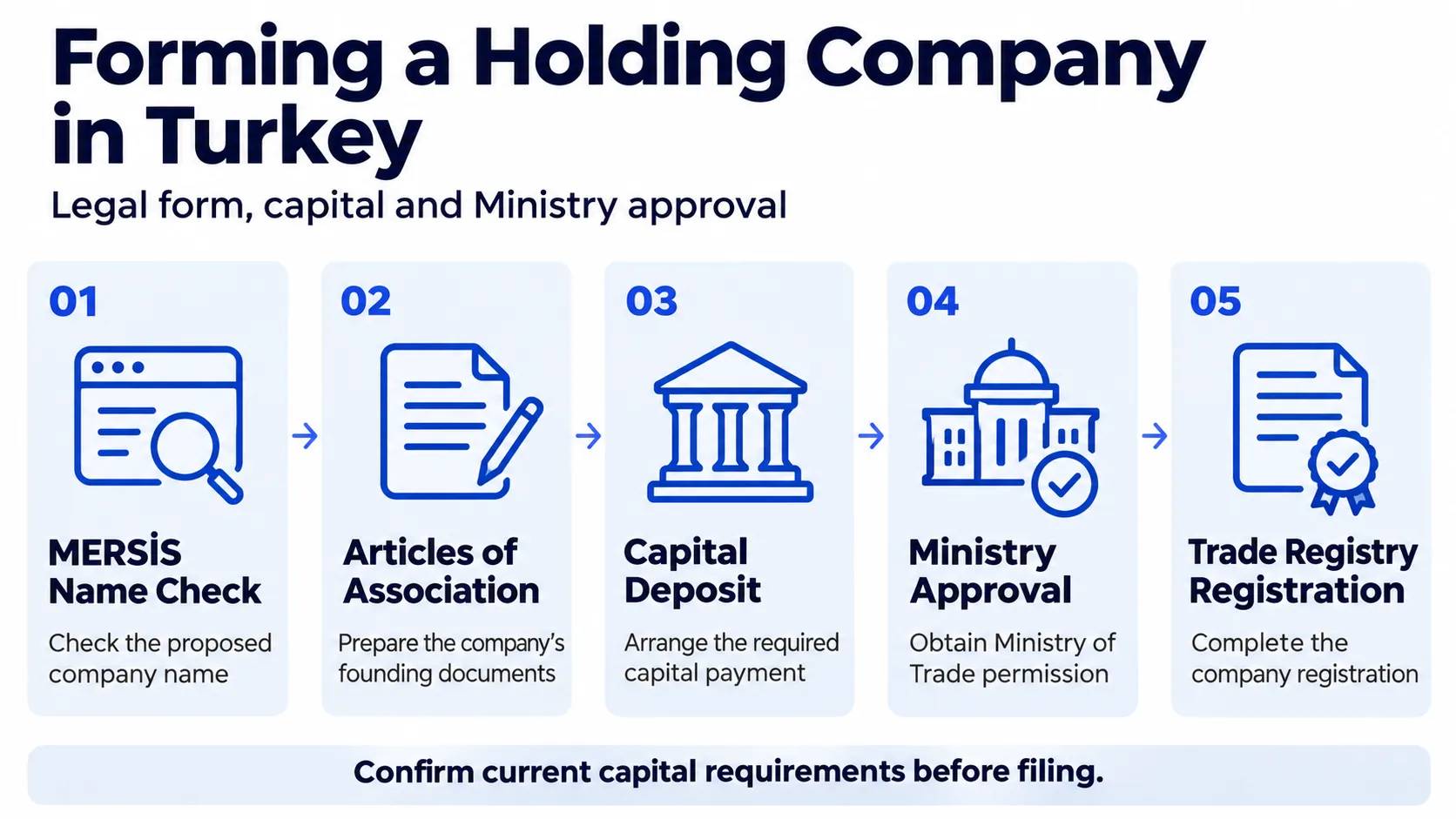
Key stages in forming a Turkish holding company, from checking the company name to preparing documents, arranging capital and obtaining approval.
Documents Required From Foreign Shareholders
Foreign shareholders create more friction than local ones, and that’s normal. Turkish authorities and banks need to know who owns the company, who controls it, and whether the documents are valid across borders. If you’re building a holding, this is one of the places where “we’ll sort it later” turns into a delay you didn’t budget for.
Individual and corporate shareholders are handled differently
An individual foreign shareholder usually needs a notarised and apostilled passport copy, proof of address or tax residency, and personal beneficial-owner declarations. A corporate foreign shareholder needs a certificate of good standing, register excerpts, a board resolution authorising the share acquisition, and identification of the ultimate beneficial owners. The paper trail is longer because the Turkish file has to show both the immediate shareholder and the people or entities behind it.
| Document |
Individual shareholder |
Corporate shareholder |
| Passport or identity copy |
Yes, notarised and apostilled where required |
For the signatory, as part of the corporate package |
| Proof of address or tax residency |
Yes |
Usually replaced by corporate registration evidence and supporting data |
| Certificate of good standing |
No |
Yes |
| Register excerpt |
No |
Yes |
| Board resolution approving the investment |
No |
Yes |
| Beneficial-owner disclosure |
Yes |
Yes, including the ultimate beneficial owners |
| Sworn Turkish translation |
Usually yes |
Usually yes |
For Turkish review, the document chain is only useful if it is legally recognised and translated properly. Apostille or consular legalisation, followed by sworn translation into Turkish, is not a formality. It’s the part that makes the file usable. Apostille and document legalisation for Turkey
Signing and translation are not optional
Original signatures matter. Scans help for pre-review, but they do not replace the signed originals when the file is submitted. That distinction catches many founders off guard. A legal file that looks complete in email can still fail at signature stage if the Turkish side cannot rely on the originals.
A lawyer or sworn translator should handle the cross-border document set. For complex multi-tier ownership, prepare the natural-person ownership and control map using the UBO identification guide; use the declaration guide for reporting obligations. These are different tasks. Don’t let a non-specialist improvise this step. The legal risk is not only missing pages, it’s mis-translated powers of attorney, invalid legalisation chains, and inconsistent shareholder data between the foreign records and the Turkish articles.
If the shareholder is a foreign company, the board resolution should clearly authorise the investment and identify who is signing on behalf of the company. If an existing Turkish subsidiary needs new capital rather than a new holding entity, follow the separate capital increase procedure. That sounds obvious, but weak resolutions are one of the most common reasons incorporation files bounce back.
Tax Rules Worth Understanding Before You Commit
A holding label does not create tax relief by itself. The tax result depends on the transaction, the ownership chain, and how profits move through the structure. If you do not test those points early, you can end up with a company that looks efficient on paper and delivers little in practice.
Participation exemption is conditional
For foreign participations, distinguish two separate corporate-tax exemption routes. The full foreign-dividend participation exemption generally requires at least 10% ownership for one uninterrupted year, a qualifying foreign corporate entity, a sufficient foreign tax burden (generally at least 15%, with special rules for certain financial activities), and remittance of dividends to Türkiye by the relevant corporate-tax return deadline. For tax periods beginning on or after 1 January 2026, a separate partial exemption may exempt 80% of qualifying foreign dividends where the Turkish corporate taxpayer holds at least 20% of the foreign company’s capital and remits the dividends within the prescribed period. This 80% route was updated by Presidential Decree No. 11257, published on 30 April 2026. It is not the same as the full exemption; eligibility must be checked for the specific dividend. See PwC Türkiye’s 2026 update and PwC’s corporate tax summary. Turkey corporate income determination and participation exemption conditions
These routes have different tests. The full exemption includes a holding-period and foreign-tax-burden test; the 80% partial exemption introduced for 2026 uses a separate ownership and remittance test. Do not mix the conditions or assume that either exemption applies automatically.
Real-estate disposals need separate tax analysis
Law No. 7456, published in July 2023, significantly changed the corporate tax treatment of gains from sales of immovable property. The treatment of an asset depends in part on when it was acquired and on the transaction’s specific facts. This is a real-estate disposal and corporate-tax question, not a special exemption or restriction that applies simply because the company is called a holding. Obtain a current, transaction-specific opinion before relying on a disposal exemption. Law No. 7456 and the 15 July 2023 real-property reserve change
Dividend withholding, treaty relief, anti-abuse rules, CFC scrutiny, and substance review can also change the outcome. So can the actual pattern of profit distribution and whether the company is doing more than passive holding. If an adviser gives you a clean, universal tax answer in the first conversation, they are overselling it.
No founder should commit capital to a Turkish holding until a licensed tax adviser has mapped ownership, source of profits, distribution timing, and substance.
Governance, Banking and Operational Setup
Once the company is incorporated, the work starts. A holding with weak governance looks fine on the registration day and becomes messy by the first board decision or banking review. Foreign founders should plan the operational backbone before they sign.
Who runs what after incorporation
Turkish company governance follows the board structure under the Commercial Code. A holding company needs proper board management, and the practical setup usually includes at least one director. If the founder is abroad, the board should establish a workable signing and representation arrangement and check whether any activity-specific residency or representation rule applies. Do not assume that every Turkish A.Ş. must appoint a Turkish-resident director.
Statutory books must be kept at the registered office, and year-end financials follow Turkish accounting rules, with audit obligations arising above the relevant thresholds. The point is simple. A holding is not a passive file in the drawer. It is a live legal entity with signing, record-keeping, and reporting obligations.
Banking is a compliance exercise, not a formality
Corporate banking for a holding usually means more than opening an account and waiting for the card. Banks will ask about the UBOs, source of funds, tax residency, and the commercial rationale for the structure. They may also limit account functionality until the company’s operating activity or investment purpose is documented.
Expect to choose between TL, USD, and EUR accounts based on the bank’s policy and the company’s actual use. The documents normally have to line up with the incorporation file, the shareholder chain, and the declared business purpose. If the bank sees a structure with unclear ownership or a weak paper trail, onboarding slows down fast.
A registered office, a qualified accountant for bookkeeping, sworn translation where required, and appropriate legal support for board decisions, share transfers and Ministry follow-up are all part of the operational picture. When a Turkish company distributes dividends to a non-resident corporate or individual shareholder, the domestic dividend withholding rate is generally 15%, subject to any applicable tax-treaty relief and eligibility requirements; dividends paid to a resident corporate shareholder are generally not subject to dividend withholding. See PwC’s withholding-tax summary. Workon can coordinate those moving parts, but the regulated tasks themselves still belong to the licensed professionals responsible for them.
Common Claims and Pitfalls for Foreign Investors
The biggest mistakes around Turkish holdings come from recycled blog content. Those articles often sound confident because they repeat the same three promises. They’re usually wrong, or at least badly oversold.
The three claims that cause the most damage
The first claim is automatic 0% tax. That’s not how the law works. Dividend and participation-exemption outcomes depend on the legal conditions already discussed, not on the word “holding” in the company name.
The second claim is asset protection by default. A Turkish holding A.Ş. is still a separate legal person liable for its own obligations. There’s no statutory shield that magically insulates the company from corporate analysis, creditor claims, or veil-piercing risk review.
The third claim is fast residency. That’s an immigration matter, not a company-registration feature. Company formation does not grant residence rights on its own, and any stay or residence route has to be assessed separately with licensed immigration counsel.
| Marketing Claim |
Regulatory Reality |
Where to Verify |
| “Holding means 0% tax” |
Tax relief depends on statutory conditions and transaction facts |
Turkish tax counsel, corporate tax review |
| “Holding protects assets automatically” |
The holding is a separate legal person and can face its own liabilities |
Turkish company law analysis |
| “Company setup gives fast residency” |
Residence is a separate immigration process |
Licensed immigration adviser |
| “Old capital amounts still apply” |
Current capital thresholds must be checked against current rules |
Ministry of Trade and registry guidance |
| “Ministry approval is a formality” |
Approval is part of the incorporation path where required |
Licensed Turkish lawyer and Trade Registry |
The practical pitfalls are boring, but they’re real. Recycled capital figures, missing tax ID or corporate ID setup, incomplete beneficial-owner filings, nominee arrangements that don’t hold up under scrutiny, and treating Ministry approval as a box-tick all create delays. For existing companies established before the 2024 capital increase, 31 December 2026 is also an important compliance deadline for raising capital to the applicable minimum, unless a later official extension changes it. This transitional rule is separate from the capital requirement for a newly incorporated holding. See the Ministry of Trade’s company FAQ. None of these are theoretical.
The rule I’d follow
Do not commit capital until a Turkish lawyer and tax adviser have reviewed the actual ownership chain, cash flow, and intended activities. If the structure involves property, distributions, or regulated sectors, the file needs deeper analysis before it moves.
Holding Company Setup Checklist
Before you sign anything, confirm the Ministry of Trade approval path, capital deposit mechanics, shareholder document chain, corporate tax registration, beneficial-owner disclosure, accounting setup, and banking compliance package. If one of those pieces is missing, the incorporation file usually slows down.
- Check the approval path: confirm whether Ministry of Trade permission is needed for your exact structure.
- Prepare the capital file: distinguish the TRY 250,000 general A.Ş. minimum from the TRY 500,000 minimum for non-public A.Ş. companies adopting the registered-capital system; confirm any sector-specific requirement and the cash-capital payment schedule.
- Clean up shareholder documents: apostille, notarised translation, and corporate authorisations should all be ready.
- Set the tax and accounting base: don’t wait until after incorporation to find a CPA or register the file.
- Plan the bank file early: UBO disclosure and source-of-funds evidence should be ready before onboarding.
If you’re deciding whether a Turkish holding fits your group, prepare a one-page ownership chart showing the proposed shareholders, existing subsidiaries, planned acquisitions, funding sources and the purpose of the Turkish parent. Workon can then coordinate the company formation path, registered address, document preparation and bank-account application support while licensed professionals assess the regulated legal and tax questions. Start with Workon if you want a single coordination point for the formation file, then take the structure to a Turkish lawyer and tax adviser before you fund it.
Frequently Asked Questions About Holding Companies in Turkey
A holding company owns shares in other companies and coordinates group ownership and management. In Türkiye, it is typically structured as a joint-stock company (A.Ş.).
Yes. Foreign individuals and companies can establish a holding company in Türkiye, subject to the applicable incorporation, documentation and approval requirements.
For a holding established as an A.Ş., the general minimum capital is TRY 250,000. Non-public A.Ş. companies adopting the registered capital system require at least TRY 500,000 in initial capital.
Yes. Holding companies established as joint-stock companies require Ministry of Trade approval for incorporation and amendments to their articles of association.
A holding company primarily owns and oversees investments in other companies. An operating company directly sells products or provides services, although some holdings also provide services to their subsidiaries.