
No—owning shares in a Turkish company does not automatically give you residence in Turkey. Company ownership, a residence permit and permission to work are three separate legal questions. A passive shareholder may own a company without living in Türkiye; a person with a genuine business or commercial connection may be assessed for a short-term residence permit; and an owner who will actively work in the business normally needs a work permit before starting work.
2026 decision rule: first define what you will actually do, then select the legal status. Do not form a company on the assumption that it creates a “business owner residence permit.” That is a marketing shortcut, not a standalone permit category.
Residence in Turkey Through Company Ownership: The Short Answer
| Your real situation |
Status to examine |
What company ownership does |
| You hold shares but do not perform productive work in Türkiye |
Company ownership plus the correct visa or lawful-stay basis for each visit |
Creates corporate rights; it does not create residence or work rights |
| You need a longer stay for a documented business or commercial connection |
Short-term residence permit under the relevant legal ground |
May supply supporting evidence, but approval remains case-specific |
| You will manage operations, provide services, sign as an active executive, hire staff or work day to day |
Work permit |
The company becomes the workplace/application vehicle; ownership alone is insufficient |
| Your real purpose is property, family, study, tourism or another qualifying ground |
The residence category matching that purpose |
Do not force an unrelated company narrative into the application |
The safest sequence is therefore activity first, permit second. If your planned conduct changes—for example, a passive investor starts managing daily operations—reassess the permit before the activity begins.

Company registration and immigration status are connected operationally, but they remain separate legal processes.
Can a Foreigner Own a Turkish Company Without a Residence Permit?
Generally, yes. Türkiye’s foreign-direct-investment framework is based on equal treatment: international investors may establish the company forms available under the Turkish Commercial Code and are generally subject to the same formation and share-transfer rules as local investors. The official Invest in Türkiye company-establishment guide separately lists a notarised residence permit only where the foreign individual shareholder is already residing in Türkiye. Sector-specific ownership, licensing or management restrictions can still apply.
This distinction prevents a common and expensive mistake:
- Right to own: your status as shareholder or investor under company law.
- Right to stay: your lawful presence under a visa, residence permit, work permit or another recognised status.
- Right to work: your authority to perform work under a work permit or a valid exemption.
One document does not automatically create the other two. Form the company because it makes commercial sense—not merely because someone has promised that incorporation guarantees residence.
Is There a “Business Owner Residence Permit” in Türkiye?
There is no standalone statutory permit named “business owner residence permit.” The closest relevant short-term category is for people establishing business or commercial connections. The Presidency of Migration Management’s current short-term residence document list asks for a visa consistent with the purpose of stay and notarised corporate evidence from the person or company to be contacted, including the activity certificate, tax registration certificate, Trade Registry Gazette and authorised-signature list.
That official wording matters. It means:
- a real, documented commercial connection can support the relevant residence ground;
- a share certificate alone is not an automatic approval;
- the declared purpose, visa history, address, insurance, financial means and complete application file must remain consistent; and
- a residence permit granted for a business connection still does not authorise active work.
For the complete route-by-route document packs, use our 2026 Turkish residence permit requirements checklist. For current property, income, address and renewal rules, see Turkey residence permit rules for 2026.
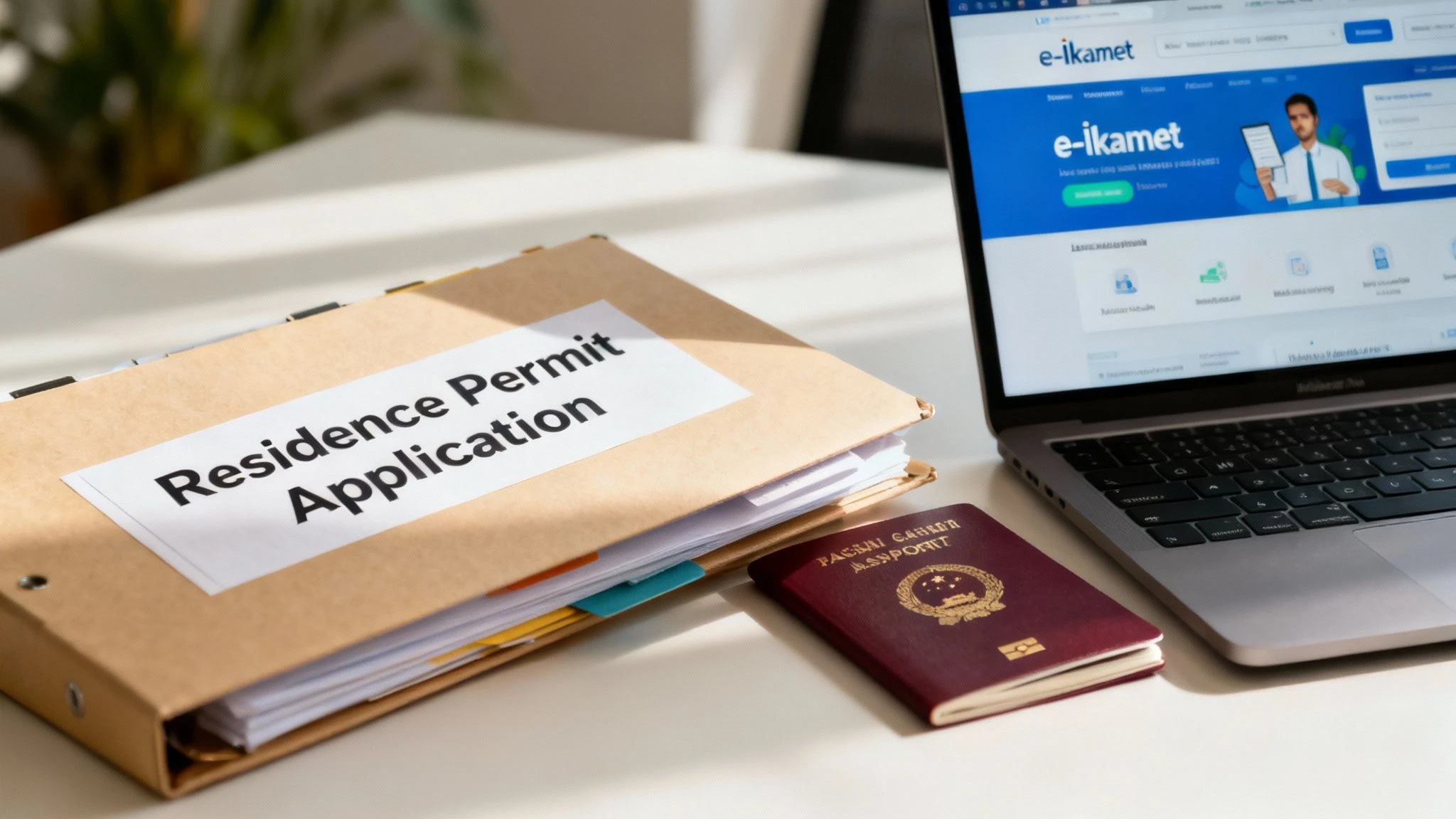
A coherent residence file must match the applicant’s genuine purpose and supporting evidence.
Passive Shareholder or Active Owner? Use the Activity Test
Job titles and share percentages do not settle the issue by themselves. Authorities can look at what the foreigner actually does. Use these practical indicators before choosing a route.
Indicators of passive ownership
- receiving shareholder information and voting on reserved corporate matters;
- appointing a properly authorised local manager;
- reviewing high-level investment performance without running daily operations; and
- visiting for limited shareholder or investor meetings under the appropriate entry rules.
Indicators of active work
- managing staff or daily workflows;
- delivering the company’s services or producing its goods;
- negotiating or signing operational contracts as the working executive;
- selling, consulting, coding, designing or otherwise performing revenue-generating work; and
- regularly representing the business as its on-site manager.
If the facts fall in the second list, do not rely on a residence card. The Ministry of Labour states that foreigners opening a workplace and working on their own account must complete the establishment steps and then obtain a work permit before starting work. See the Ministry’s official company/workplace process.
If the Owner Will Work: Check Eligibility Before Committing to the Structure
A company that can be incorporated is not necessarily ready to support its owner’s work-permit application. The owner’s actual role, capital share, the company’s paid-up capital, ownership percentage, employment requirements and any applicable exception need a separate review. A capital contribution or company registration alone is not an approval.
Use the company-owner work-permit eligibility guide for the current tests and worked examples, and confirm the live Ministry evaluation criteria before relying on an investment plan. This residence decision remains the same: ownership does not itself grant residence or permission to work, and a criterion exception does not guarantee a permit.

Check both the owner-specific criteria and the actual work activity before submitting an application.
Use our company-owner work permit eligibility guide to test the thresholds. Once eligibility is clear, follow the separate company-owner work permit application guide for the filing route and evidence. The broader Turkish work permit guide explains permit types and employer-side responsibilities.
Does the Work Permit Also Cover Residence?
For ordinary fixed-term, permanent and independent work permits, yes: the Ministry states that the valid work permit grants the right to work and reside during its validity period and substitutes for a residence permit. Special protection-status permits are an exception and do not substitute for residence permits.
This produces two very different plans:
- Genuine non-working business connection: assess the short-term residence ground and maintain a separate prohibition on productive work.
- Active owner-manager: assess work-permit eligibility and use the work authorisation that also carries the ordinary residence effect during its validity.
The official explanation is available on the Ministry’s Documents Issued to Foreigners page.
Build the Company and Permit Files Separately
A clean project has two coordinated workstreams. Mixing them creates missing documents and false expectations.
Corporate file
- commercially suitable company type and activity scope;
- MERSİS and Trade Registry formation records;
- foreign shareholder identity, translation, notarisation or apostille formalities where required;
- tax registration, registered address and authorised-signature records;
- banking, accounting, beneficial-ownership and sector-licensing controls; and
- capital structured for the real business plan and any later work-permit test.
Personal immigration/work file
- the applicant’s actual purpose and day-to-day activity;
- the correct residence, work-permit or exemption route;
- lawful entry and filing eligibility;
- passport validity, address, health cover and financial evidence where applicable;
- route-specific corporate documents; and
- a timeline that prevents work from starting before authorisation.
If you still need to establish the entity, start with our foreign-founder company setup guide. Incorporation should be designed around the business model, ownership, tax position and permit strategy together.

Coordinate company registration, tax setup and the owner’s immigration route from the beginning.
Documents That Commonly Connect the Two Files
The exact request depends on the route and the reviewing authority. Typical corporate evidence that may connect a business-based residence or owner-work-permit file includes:
- Trade Registry Gazette showing formation, ownership or management changes;
- current chamber activity certificate;
- tax registration certificate;
- authorised-signature list or signature circular;
- articles of association and share/capital evidence;
- workplace address and sector licences where relevant;
- payroll and SGK records when employment criteria apply; and
- evidence explaining the applicant’s real activity and why the requested status matches it.
Do not treat this as a universal checklist. Download the current authority list for the exact route and reconcile names, dates, addresses, ownership percentages and capital across every document.
Company Compliance Does Not Automatically Renew a Permit
A company can be fully compliant while its foreign owner lacks the correct personal status. Equally, a valid residence card does not excuse late tax, accounting, payroll, SGK, licensing or corporate filings. Keep three calendars:
- company calendar: accounting, tax, registry, licence and reporting deadlines;
- residence calendar: expiry, extension window, address and notification duties; and
- work calendar: permit validity, permitted workplace/role, employee criteria and extension timing.
Renewal is never secured merely because a company still exists. The authority can reassess whether the legal ground and required evidence continue to exist.
What Company Ownership Does Not Automatically Provide
- No automatic residence: each applicant needs an approved legal basis.
- No automatic permission to work: active work normally requires authorisation before it begins.
- No automatic family status: a spouse or child needs a separate application and must satisfy the applicable conditions.
- No automatic citizenship: company ownership and ordinary residence are not themselves a citizenship grant.
- No guaranteed renewal: every extension is assessed under the rules and facts applicable at that time.
Pre-Filing Decision Checklist
- Describe the activity: write down exactly what the foreign owner will do in Türkiye each week.
- Classify it: passive ownership, commercial connection or active work.
- Test the route: confirm the residence ground or owner-work-permit criteria using current official sources.
- Check filing eligibility: determine whether the application must be made domestically or through a Turkish mission abroad.
- Align the company: verify ownership, paid-up capital, activity code, address, authorisations and staffing.
- Reconcile documents: eliminate inconsistent names, dates, addresses and share figures.
- Protect the start date: do not begin active work before the necessary authorisation is valid.
Go: the real activity, corporate structure and chosen permit match.
Fix first: evidence is incomplete, capital is unpaid, the role is unclear or corporate records conflict.
Stop: the plan depends on company ownership automatically granting residence or allowing work.
Plan Your Company and Immigration Route Together
The strongest strategy is not “open a company, then hope for residence.” It is a documented sequence in which the business has a commercial purpose, the owner’s real activity is classified correctly and each application is built for the right authority. Workon can coordinate the company-registration and operational-readiness workstreams and, where SMMM/CPA, legal or immigration-professional work is required, coordinate the relevant handoff while keeping the regulated professional and authority decisions distinct.
Review Workon’s residence and work permit services or request a case-specific assessment before committing capital or starting operations.
No. Company ownership, residence status and permission to work are separate legal questions. A shareholder may own a company without living in Turkey, while a longer stay or active work requires the appropriate immigration or work-authorisation route.
No. There is no statutory permit with that name. A genuine business or commercial connection can be relevant to a short-term residence-permit ground, but the applicant's purpose, corporate evidence, address, insurance, financial means and other current requirements are assessed case by case.
Generally yes. Foreign investors can generally establish and own Turkish companies without a residence permit solely for share ownership, subject to sector-specific restrictions. Ownership does not itself create a right to stay or work.
If the owner will actively manage operations, provide services, perform revenue-generating work or otherwise work in the Turkish business, the applicable work permit or exemption should be assessed before the activity begins. A residence card or shareholding alone is not work authorisation.
For the ordinary balance-sheet company-partner route described in the article, current criteria generally include at least TRY 500,000 of the foreign partner's own capital share, at least TRY 500,000 total paid-up company capital, at least 20% ownership and five Turkish employees from permit month seven onward. The Ministry also states a USD 100,000 own-capital-share exception to those specified owner criteria. The live criteria and other permit conditions must be checked before filing.
For ordinary fixed-term, permanent and independent work permits, the Ministry states that a valid work permit also grants the right to reside during its validity and substitutes for a residence permit. Special protection-status cases can follow different rules.
Disclaimer: Last reviewed 17 September 2026. This guide provides general information, not legal, immigration, tax or investment advice. Residence and work-permit outcomes depend on the applicant, activity, nationality, company, sector and current administrative practice. Verify the live requirements with the Presidency of Migration Management and the Ministry of Labour, and obtain qualified professional advice before forming a company, filing an application or starting work.