
Choosing a registered business address in Turkey is mainly an operating-model decision. A private office, serviced/shared office, virtual office or home/owned premises can each be workable in the right circumstances. The best option depends on what the company actually does, whether staff/customers/stock/equipment need a physical location, what premises-specific rules apply and what right-to-use documents support the address.
This guide explains the address-model comparison. For the minimum legal-address and MERSİS/UAVT requirements, use the legal business address guide. For terminology such as legal vs registered vs mailing address, use the address terminology guide.
Compare the Main Registered-Address Models
| Address model |
Often a good fit for |
Main question before signing |
| Private/dedicated office |
Teams or activities that genuinely need exclusive daily premises |
Does the property and lease/right of use fit the intended activity, staffing and any licensing requirements? |
| Serviced/shared office |
Businesses needing recurring workspace plus administrative support |
What exact address-use, workspace, mail and premises rights are included in the agreement? |
| Virtual office |
Many remote-first service, consulting, software and market-entry models without dedicated daily-premises needs |
Does the company’s activity fit, and does the agreement genuinely support registered-headquarters use of the exact premises? |
| Home/owned premises |
Cases where the property, right of use and activity are compatible |
Do building, landlord/co-owner, privacy, activity and premises-specific requirements make the arrangement workable? |
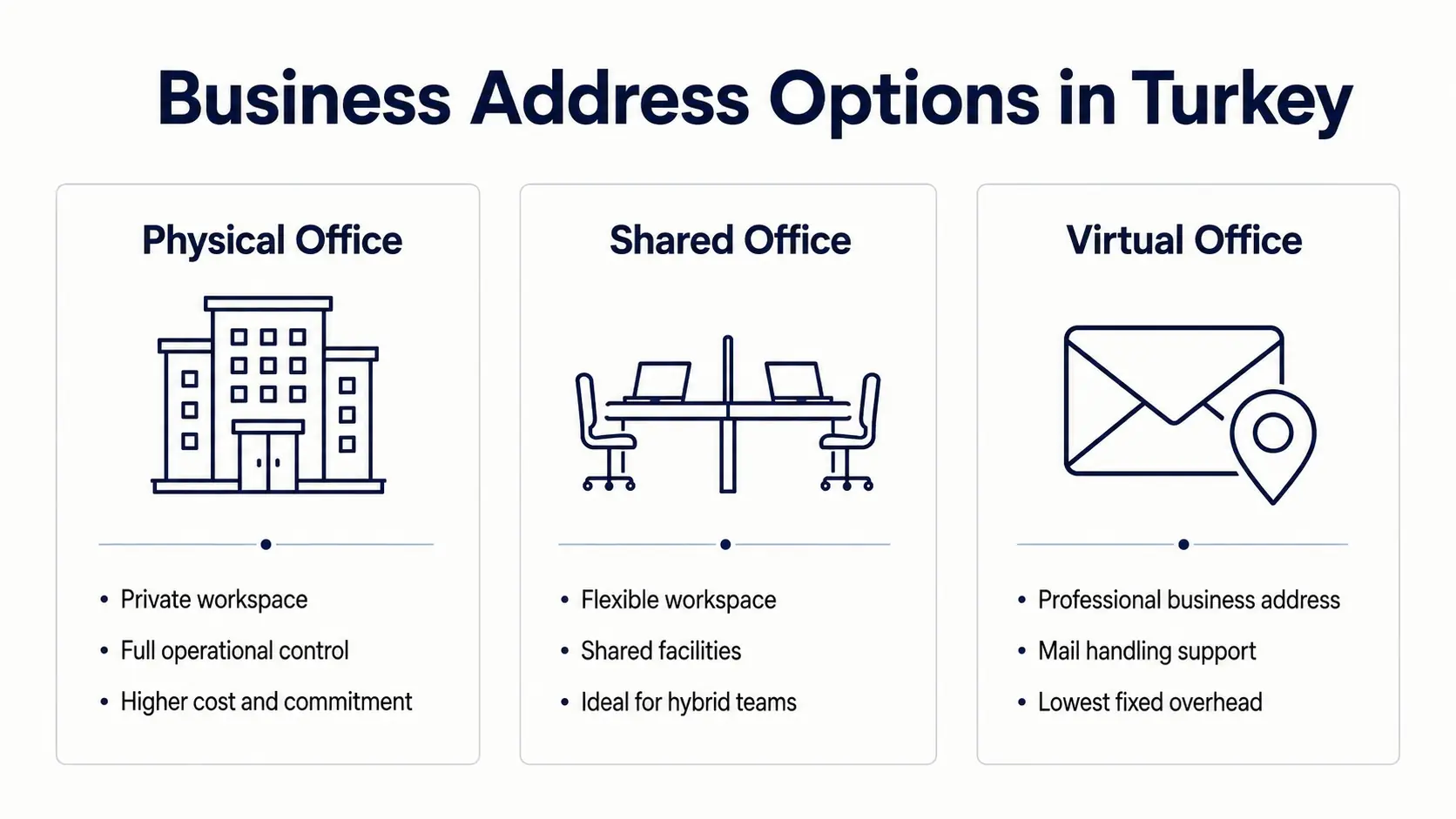
Choose the address model by activity, right-to-use documentation and operational needs rather than image alone.
Decision rule: start with the activity and operating premises the business genuinely needs; then choose the address model that can support those facts.
What Every Model Still Has to Solve
The choice of physical, shared, virtual or home premises does not remove the basic registered-address requirements. The company still needs an identifiable headquarters, a genuine right to use the premises and records that remain consistent across the applicable company and tax systems.
For MERSİS-based company procedures, the Ministry of Trade’s MERSİS system works with official address data. The legal minimums and right-to-use evidence are covered in the MERSİS/UAVT legal-address guide.

Whichever premises model is chosen, the headquarters and supporting documents should refer to the same identifiable location.
When a Private Office Makes More Sense
A dedicated office is usually easier to justify operationally when the business genuinely needs exclusive premises. Typical signals include:
- regular on-site employees;
- frequent customer or counterparty visits;
- inventory, equipment or records that need dedicated storage;
- production or workshop activity;
- premises-linked municipal or sector licences; or
- a business model that cannot credibly operate from an administrative address alone.
A private lease is not an automatic regulatory advantage and does not guarantee tax-office or bank acceptance. The property, right of use and activity still need to fit the company’s actual case.
When a Serviced or Shared Office Makes More Sense
A serviced/shared office can be useful where the company wants a recurring desk, meeting rooms and administrative support without taking full responsibility for an entire leased office. The key question is what the contract actually grants.
Confirm separately:
- whether the address can be used as the company’s registered headquarters;
- what workspace access is included;
- how official mail is logged and forwarded;
- what premises-side documents support the company’s right of use; and
- whether the company’s activity needs a more exclusive or specially licensed operating site.
When a Virtual Office Makes More Sense
A virtual-office model can be practical for many remote-first service, consulting, software, agency and early market-entry businesses that do not need dedicated daily premises. It can reduce fixed premises commitments while still giving the company a documented headquarters and administrative support.
It should not be treated as automatically suitable for every company or activity. If employees, customers, stock, production, regulated equipment or licensing requirements need a physical operating location, the company may need dedicated or additional premises.
For LLC-specific examples, use the LLC activity-and-premises suitability guide.
When Home or Owned Premises May Work
A home or already-owned premises can be workable for some business models, but “I control the property” is not the end of the analysis. Check the activity, the legal/right-of-use basis, any building or co-owner restrictions, privacy implications, customer/staff use and any municipal or sector-specific premises conditions.
The company headquarters also should not be confused with the founder’s personal residence-address requirements.
A Five-Step Address Decision Framework

Review the operating model and address-use agreement before the headquarters enters the company file.
- Map the real activity. Where will staff work, customers visit, stock sit, equipment operate and regulated services be delivered?
- Identify premises-linked rules. Check whether the activity needs a particular licence, municipal approval or physical operating site.
- Choose the minimum premises model that still fits. Do not rent a large office only for image, and do not force an address-only model onto an activity that needs real operating premises.
- Validate the right-to-use file. Confirm the exact premises, agreement, provider/owner authority and supporting documents before filing.
- Plan the post-registration workflow. Define official-mail handling, tax-office verification readiness and the address-change process if the company later moves.
How the Address Enters Registration and Tax Records
The registered headquarters appears early in the company file and should remain consistent through later records:
- MERSİS/Trade Registry: use the exact official headquarters and the supporting address arrangement applicable to the company.
- Tax records: keep the same underlying headquarters information after taxpayer registration.
- Tax-office yoklama: treat GİB verification as a separate process from company registration. Current guidance sets a maximum 15-day administrative completion period for commencement yoklama after taxpayer status is established; it is not a promised physical-visit date.
- Later company records: keep invoices, contracts, KYC files and other company documents traceable to the same headquarters until a formal change is completed.
For the detailed verification process, use the tax-office yoklama guide. For company-data consistency, use the company address consistency guide.

Workon coordinates company registration, registered-address and related operational setup for foreign founders.
Compare Contracts, Not Marketing Labels
Two products both called “virtual office” or “serviced office” can give very different rights and operational support. Before signing, compare:
- the exact registered-headquarters right;
- provider/owner authority over the premises;
- mail receipt, notification, scanning, storage and forwarding;
- meeting/workspace access;
- authority-contact procedures;
- contract term, renewal and exit rules; and
- what happens if the provider changes or loses the premises.
Current Workon commercial pricing and package inclusions belong on the live virtual office service page, not in this long-lived decision guide.
Mistakes to Avoid

Address inconsistencies and weak right-to-use documents can create avoidable registry and tax follow-up.
- Choosing by price alone: compare the legal/address-use rights and operational service scope as well as cost.
- Assuming every virtual office works for every activity: activity and premises requirements remain decisive.
- Assuming a private office guarantees acceptance: a lease alone does not determine tax, bank or sector-regulatory outcomes.
- Mixing different address versions: keep one master registered-headquarters record.
- Confusing mail handling with registered-address rights: they are different functions.
- Choosing a prestige district before checking the file: location can matter commercially, but it does not replace correct documents or activity fit.
If the Company Later Moves
The first address does not need to be permanent. If the operating model changes, the company can move its headquarters through the applicable corporate, Trade Registry and tax procedures. Do not update only the website or invoice template.
Use the company address change guide when the headquarters changes.
If a virtual or serviced address fits your business model, review Workon’s virtual office service in Turkey. Workon can coordinate the registered-address setup and, where the project requires activity-specific premises, licensing, legal or tax work, align the process with the appropriately licensed or authorised professionals.
Frequently Asked Questions
Yes. A company needs a registered headquarters that can be recorded in the Trade Registry and tax records and used for official correspondence. The exact premises and right-to-use basis should be identifiable and documentable for the chosen setup.
A virtual-office arrangement may be suitable where the company has a genuine right to use the exact premises as its registered headquarters and the activity does not require a different operating site. The service label alone is not a blanket approval for every LLC, JSC or regulated activity.
It may be possible in some cases, depending on who owns or leases the property, the company’s right to use it, building or co-owner restrictions, privacy and the actual business activity. Landlord, building-management or other consent should not be treated as a universal requirement without checking the specific arrangement.
Yes. A genuine headquarters move should be completed through the applicable corporate, Trade Registry and tax-update process. Updating only invoices, the website or internal templates does not complete the formal change; later company records should use the new official address after the change is effective.
Last reviewed: 13 September 2026. Registered-address suitability, premises evidence, yoklama and activity-specific requirements depend on the company, premises and current rules; Workon can coordinate the relevant setup and professional handoffs according to the agreed scope.