Starting an IT startup in Turkey is not a single company-registration task. A founder needs to connect the legal entity to ownership/IP, accounting, bank access, invoicing, customer contracts, data/privacy, hiring/work permits and the right funding or incentive route.
The most useful 2026 launch sequence is: validate the operating model → choose the company and cap table → register the entity → activate accounting/banking/document controls → sign the first real customer → hire only when the role is ready → apply for funding/incentives only after the correct route is identified.
Last verified: 17 September 2026. This guide explains the practical founder-to-first-90-days startup roadmap. For current funding and incentive routes, use the 2026 IT startup incentives guide. For broad software-company incentives, use the software & IT incentives hub.

Build the company, evidence, customer and funding stack in the right order.
Your 90-Day IT Startup Roadmap
| Period |
Primary goal |
Evidence before moving on |
| Days 0-14 |
Validate company/ownership/market structure |
Founder roles, cap table, legal entity choice, IP position, target customer and first operating budget |
| Days 15-30 |
Register and activate the company |
Trade Registry/tax/corporate records, accounting owner, bank KYC file, authority/signature evidence |
| Days 31-60 |
Make the business transaction-ready |
Invoice/payment route, contracts, privacy/data controls, product/MVP evidence and first customer pipeline |
| Days 61-90 |
Build repeatable growth/funding readiness |
Customer/revenue data, monthly close, hiring plan, funding/incentive route and investor/application evidence |
Days 0-14: Decide What Company You Are Actually Building
Do not incorporate before the founders agree on the operating model. A software consultancy, SaaS company, game studio, mobile-app publisher, AI product startup and regulated fintech can all need different contracts, licences, incentives and team structures.
Before formation, write a one-page founder operating brief covering:
- the product/service and who pays for it;
- Turkey-only versus international customers;
- subscription, licence, project, commission or marketplace revenue;
- who owns existing code, models, domains, brands and datasets;
- founder share percentages and decision rights;
- which founder will actively manage the Turkish company;
- expected first hires and contractors;
- first 12 months of cash needs; and
- whether Technopark, TÜBİTAK, KOSGEB, Ministry of Trade or private investment is a realistic later route.
This brief prevents the company documents from being drafted for a generic “software business” that does not match how the startup will actually earn money or raise capital.
Choose Ltd. Şti. or A.Ş. Based on Ownership and Funding Plans
Foreign investors can generally establish Turkish capital companies under the same company-law framework as domestic investors, subject to sector-specific restrictions.
| 2026 point |
Ltd. Şti. |
A.Ş. |
| Minimum capital |
TRY 50,000 |
TRY 250,000 under the ordinary capital system; TRY 500,000 starting capital if the registered-capital system is adopted |
| Pre-registration capital rule |
No universal 25% deposit; subscribed capital may be paid within the statutory post-registration period |
At least 25% of subscribed capital is generally paid before registration, with the balance under the statutory timetable |
| When it may fit |
Founder-led operating startup, simpler initial ownership/management |
More complex investment/governance/share-structure plans |
Do not use the slogan “A.Ş. is always for investors” as a substitute for legal design. Investor rights, share transfers, board governance, option plans and future rounds should be considered before the articles/shareholder arrangements are finalized.
For the detailed company-type decision, use the Turkey company-type guide.
Protect the IP Before the Company Starts Selling It
For a technology startup, the most valuable asset may be created before incorporation. Do not assume the new company automatically owns code, designs, datasets, domains or other intellectual property created by founders, freelancers or a prior foreign company.
Build an IP chain-of-title file:
- identify pre-existing founder/third-party IP;
- document any assignment or licence to the Turkish company;
- use contractor/employee agreements that address ownership and confidentiality under applicable law;
- keep open-source/software licence records;
- register/secure domains and key platform accounts in the correct legal owner’s name; and
- consider trademark protection for the operating brand.
Investor due diligence can stall even when the product works if the startup cannot prove who owns the code or brand.
Days 15-30: Register the Company and Build the Corporate File
The formation process should produce a clean corporate evidence stack, not only a Trade Registry certificate. For a foreign-owned company, the exact formation documents depend on whether the shareholder is an individual or legal entity and on the country/route of the foreign-issued documents.
Common controls include:
- MERSIS/Trade Registry formation records and articles;
- registered Turkish business address;
- shareholder and management records;
- taxpayer/tax-office records;
- authority/signature evidence;
- foreign-document translations and apostille/legalisation evidence where required;
- current Gazette/chamber evidence where later institutions request it; and
- a controlled digital folder containing the final signed versions.
Company formation can often be coordinated through properly authorised representatives, but remote incorporation should not be confused with guaranteed remote corporate banking.
For the complete formation workflow, use the 2026 company formation guide.

Connect company registration to the startup’s bank, accounting, customer and funding plan.
2026 ETDS: New Company Books Need an Owner from Day One
For companies whose establishment is registered from 1 January 2026, the share ledger and general assembly meeting/negotiation book are kept electronically in the Electronic Commercial Ledger System (ETDS) under the current Ministry framework. The relevant books are opened automatically with registration; the board-resolution book is optional in electronic form under the current announcement.
Assign responsibility for corporate records immediately. A later funding, bank or due-diligence process is easier when ownership/management changes are documented correctly as they occur.
Accounting: Build the Monthly Close Before Revenue Arrives
A startup should know how each customer payment will become an invoice, accounting entry, tax record and management metric before the first meaningful volume arrives.
Set up:
- bank/payment-provider reconciliation;
- invoice/e-Fatura/e-Arşiv decision ownership;
- VAT treatment by product/service/customer route;
- foreign-currency accounting for international revenue/costs;
- contractor and employee expense evidence;
- R&D/project cost tags if future support is expected;
- monthly management P&L/cash runway; and
- filing/payment calendar with the company’s licensed accounting professional where required.
Do not wait for an incentive application to reconstruct R&D costs. If a project may later enter TÜBİTAK or Technopark, build project-level evidence from the start.
Corporate Banking: Treat It as a Separate Gate
Company registration does not guarantee corporate bank approval. Turkish banks apply independent KYC/AML and risk controls.
A startup bank file should be able to explain:
- shareholders/UBOs and source of funds;
- signing authority;
- product/service and customer countries;
- expected currencies, counterparties and volumes;
- funding/investor sources;
- website/app or contracts supporting the business model; and
- why the account activity will match the registered company activity.
Some cases can use remote/coordinated banking paths; other institutions/cases can require physical steps. Use the business bank account guide for the current onboarding decision.
Days 31-60: Make the Startup Customer-Ready
The next milestone is not “launch the website.” It is being able to sign, invoice, collect, deliver and support the first real customer without inventing processes after the sale.
Customer contract
Match the contract to the actual model: SaaS subscription, software licence, development project, support/maintenance, API/data service or marketplace relationship. Define scope, price/currency, acceptance/delivery, IP, confidentiality, data processing, service levels, liability, termination, tax/invoice and dispute provisions with appropriate legal review.
Privacy and data
If the product processes personal data, map data subjects, data categories, purposes, legal bases, processors/subprocessors, cross-border transfers, security, retention and user rights under the applicable Turkey/KVKK rules. GDPR experience does not automatically satisfy Turkish obligations.
Payments and invoicing
Decide how customers will pay and how each payment will reconcile to the correct invoice/document route. A B2B SaaS bank transfer, card subscription and app-store revenue can create different operational records.
For merchant acquiring, use the Virtual POS in Turkey guide. For e-invoicing, use the e-Fatura registration guide.
Validate the First Customer Before Expanding the Team
A founder can waste months optimizing the company for hypothetical scale. Before hiring aggressively, try to prove:
- a clearly defined buyer/user;
- a repeatable problem worth paying for;
- at least one credible acquisition channel;
- pricing that survives delivery/support costs;
- a measurable sales cycle;
- product usage/retention signals appropriate to the model; and
- customer objections that can be addressed in product or positioning.
Funding and incentives can extend runway, but they should not replace basic market validation.
Hiring: Separate Local Employment from Founder Work Authorization
When the startup hires Turkish employees, build the recruitment-to-start, SGK and payroll process before the first working day. Use the 2026 hiring checklist and payroll guide.
For foreign founders, share ownership does not automatically authorize active work in Turkey. If a foreign shareholder will manage or work productively in the Turkish startup, run the company-owner work-permit test before starting that role. The current dedicated owner is the company-owner work-permit eligibility guide.
2026 IT-sector point: the Ministry’s current work-permit criteria generally do not apply the standard employment and financial-eligibility tests to applications for qualifying specialist IT roles—such as software development, database, mobile software, systems/network/security and enterprise architecture—in workplaces operating in the IT sector. This is not an automatic work permit and does not replace the separate analysis of whether the foreign person is applying as a company owner/manager or in a qualifying specialist role.
Days 61-90: Choose Funding After the Evidence Exists
Founders assessing age-based support should compare the eligibility and scope of tax relief, KOSGEB support and loans in the Turkey youth entrepreneur support guide before adding any benefit to the budget.
Do not treat “funding” as one pipeline. The correct 2026 route depends on the startup stage and project.
| Need |
Route to test |
| Founder-stage technology idea / pre-seed |
BiGG call-cycle eligibility |
| SME R&D project |
TÜBİTAK 1507 |
| Larger continuing industrial R&D project |
TÜBİTAK 1501 |
| General eligible new-SME business-development costs |
KOSGEB call-cycle support |
| Ongoing qualifying software/design/R&D with tax/payroll needs |
Technopark / Law 4691 |
| Software/service exports |
Ministry of Trade support routes |
| High-growth equity financing |
Angel/VC/private venture capital |
Before preparing an application, check the programme’s current eligibility conditions and submission window in the IT startup incentives route guide. For investor selection, dilution and fundraising preparation, use the venture capital guide.
Technopark: Apply for Project Fit, Not Because the Startup Pays Tax
A Technology Development Zone can be valuable when the startup has genuine qualifying software/design/R&D work and can maintain the required project/accounting/personnel evidence. It is not simply an office with automatic 0% tax.
Use the Technopark admission guide to choose a zone and prepare the project, and the Technopark incentives tax guide for the qualifying profit/personnel/VAT rules.
Investor-Ready File by Day 90
Even if you are not raising immediately, a clean startup should be able to assemble this file:
- current Trade Registry/corporate documents;
- cap table and founder/shareholder agreements;
- IP assignment/licence records;
- bank statements and source-of-funds records;
- monthly accounting/P&L/cash runway;
- customer contracts/pipeline and revenue evidence;
- product usage/technical roadmap;
- employee/contractor agreements;
- data/privacy/security documentation appropriate to the product;
- incentive/grant obligations already accepted;
- material tax/compliance filings; and
- a 12-18 month use-of-funds plan.
This evidence helps not only investors but also banks, grant evaluators, Technoparks and larger enterprise customers.
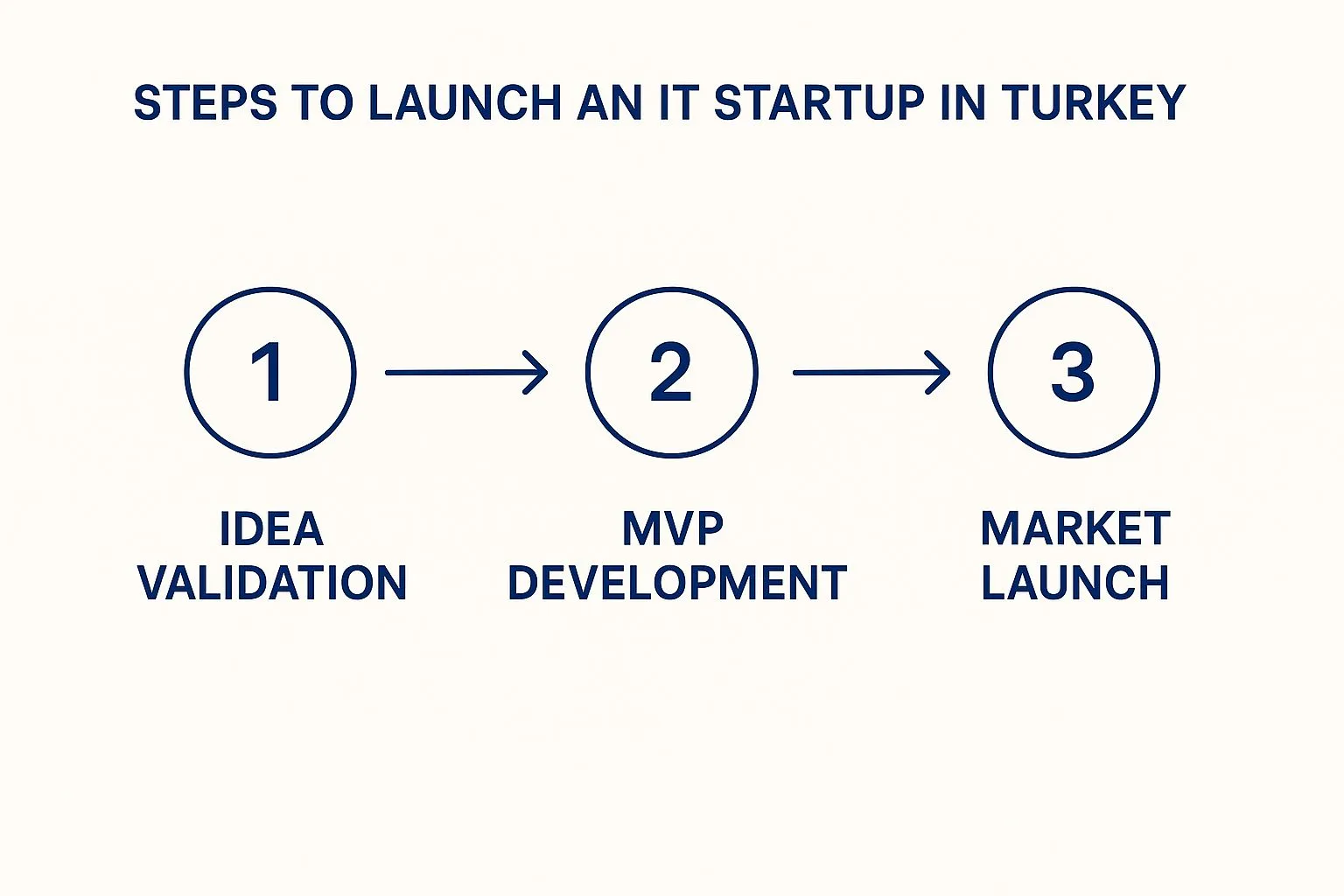
Make each startup milestone produce evidence that supports the next bank, customer, hiring or funding decision.
Common Launch Mistakes to Avoid
- Incorporating before founder ownership/IP is agreed.
- Choosing A.Ş. or Ltd. Şti. from a slogan instead of the cap-table/governance plan.
- Assuming every formation document must be notarized or every company needs the same foreign-document pack.
- Applying the A.Ş. 25% pre-registration capital rule to a Ltd. Şti.
- Assuming remote incorporation means remote bank approval.
- Starting paid work as a foreign owner without resolving work authorization.
- Using old “0% Technopark” or “all grants are non-dilutive” statements in the financial model.
- Hiring before the first repeatable customer/acquisition evidence.
- Applying to every incentive instead of one route that matches the project/stage.
- Keeping company, accounting, bank, IP and product evidence in separate inconsistent versions.
How Workon Supports an IT Startup Launch
Workon can coordinate the operational foundation for foreign and local technology founders: company formation, registered business address and office solutions, foreign-document workflow, corporate records, bank-account application support, first compliance handoff and incentive-readiness coordination.
Legal, tax, accounting, immigration, data-protection, IP and grant-technical matters should be handled by the appropriately qualified/licensed professional for the specific issue. Banks, public agencies, Technoparks and investors make independent decisions; Workon does not guarantee bank approval, incentive acceptance, tax exemption or funding.
Review Workon’s Turkey company registration support and use the 90-day roadmap above to define the post-incorporation work before the Trade Registry filing is finalized.
Generally yes. Foreign investors can generally own Turkish capital companies under the same company-law framework as domestic investors, subject to sector-specific restrictions. Ownership does not by itself grant the foreign founder a right to work in Turkey.
The current general minimum is TRY 50,000 for an LLC and TRY 250,000 for a JSC under the ordinary capital system; a JSC using the registered-capital system has a TRY 500,000 starting-capital threshold. The LLC does not have a universal 25% pre-registration deposit rule; a JSC generally requires at least 25% of subscribed cash capital before registration.
Do not use one universal one- or two-week promise. Legal registration is only one milestone; foreign documents, accounting, banking and KYC, invoicing, customer contracts, data controls, work authorisation and any regulated or incentive route have separate dependencies.
No. Banks apply their own KYC, AML and risk review to the company, founders and UBOs, source of funds, business model, expected customers and transactions. Remote incorporation also does not guarantee remote banking.
No. Technopark, TÜBİTAK, KOSGEB, Ministry of Trade and other routes have separate project, company, expenditure, timing and evidence requirements. Do not build an exemption or grant into the financial model until the relevant eligibility is confirmed.
Build a clean corporate and cap-table file, IP chain of title, accounting and bank records, customer and revenue evidence, employment or contractor documentation, privacy and security controls appropriate to the product, and a realistic use-of-funds plan. These records support banks, customers, investors and funding applications.
No. Current Ministry criteria generally waive the standard employment and financial-eligibility tests for qualifying specialist IT roles in IT-sector workplaces, including listed software, database, mobile, systems\/network\/security and enterprise-architecture roles. A work permit is still required where applicable, and the correct application basis must distinguish a company owner or manager from a qualifying specialist role.
Disclaimer: This article provides general information about starting and operating an IT startup in Turkey as of September 2026 and is not legal, tax, accounting, immigration, investment, IP, employment or data-protection advice. The correct structure and sequence depend on the founders, product, customers, sector, funding plan and current rules. Confirm material incorporation, contracting, tax, employment, work-permit and funding decisions against current official requirements and with appropriately qualified Turkish professionals.